Walk down the street for English

Coreografía del anonimato
Maite Iracheta
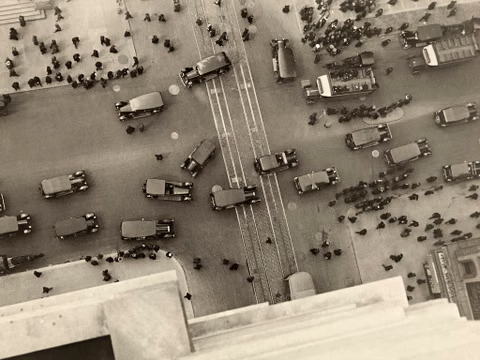
Sales a las calles de Nueva York, peatón anónimo, para no parar hasta alcanzar tu destino, el tipo de destino al que, en esta ciudad, dicho sea de paso, rara vez se llega. Entras al juego del continuum de engranarse y esquivar, del trayecto hecho sobre la marcha, con un ritmo al que el pulso urbano se liga y acompasa. Es la metrópolis dictando su metrónomo. Los cuerpos navegan en el espacio midiéndose entre otros cuerpos tan familiares en su anonimato que la coreografía es precisa; su compás impredecible, exacto. Y si no me sigues, dirígete a la escuadra de la Quinta Avenida y la Calle 42 de Manhattan. A vista de pájaro observa lo que ocurre: los que andan, se cruzan y entretejen por momentos, se anudan de repente, al siguiente paso se deshilan y continúan su curso como miles más, como parte de esos miles que son, porque hasta cuando parece que están cerca de chocar salen sin codazos, puntapiés o tropezones, ni una gota derramada del café to go; cumplen con acrobacias avanzadas entre itinerarios sincopados, convergen en repentinos instantes, y si casi se dan de frente, de inmediato se recomponen y reconfiguran en variadas secuencias de murmuraciones con tracción terrena, distintas al cálculo aéreo de los estorninos. Por esas vidas apuradas y apretadas, en las vías solo se puede improvisar. O tal vez no: tal vez cada peatón desarrolla al paso de las millones de calles por las que ha caminado una brújula interna, intuitiva, de propulsión avante que le guía, que se conecta con una versión elemental de bluetooth topológico, analógico, el toque mágico para su street smarts. Hay una antena invisible, inmaterial, de la que aún no se han escrito libros (ni se escribirán) a la que todos los bípedos ciudadanos se sintonizan, coordinados misteriosamente a la frecuencia de esta azarosa danza.
Extraerse de la marea alta de la calle es difícil, pero logras arrancarte de la corriente para irte a refugiar en la biblioteca pública de esa misma encrucijada, qué suerte. Pasas un rato en la sala de lectura principal, tranquila, respirando; no lees, tú eres el libro, un libro cerrado. Pero al rato te hartas del reposo, te abres y te levantas, bajas rápido por la escalera, lanzas un beso a Fortaleza y Paciencia que lo perciben todo –ese temblor incesante de la calle– y al tocar la acera, entras en circulación a la coreografía del anonimato. Vas armada: te acompañan tus reflexiones y algunas ideas geniales que no recordarás cuando tengas la pluma en la mano (eran indomables, al destino no se llega); el vaivén de tus piernas a merced de la dirección colectiva, a un dictado familiar (la madre de todos, reconócelo, es la calle) que nutre y regenera nuestra querida inteligencia transeúnte. Convives con la explosión demográfica –tú eres, de hecho, uno de sus incontables booms, y por cada boom, más pavimento. En esta multiplicación del hormigueo urbano a la hora pico, te transformas en el trazo efímero de un holograma agitado, difuminado, corriente nerviosa de otro día más. Percibes que con su diario ensayo, la coreografía se reanima, persistente al prescindir de partitura. Eres parte y lado de una banda de Möbius en la fluida geometría de la multitud andante, interminable. Crees que ahora sí vas a llegar. Te emocionas y te envuelves, te tuerces extrañamente para esquivar a todos: cyborgs y vehículos, y no dejas de moverte por la cuadrícula citadina, aunque te vean, te fijen, para siempre, las cámaras de vigilancia.
A Maite Iracheta le gustan las calles de arena.
Choreography of Anonymity
Maite Iracheta
You step out onto the streets of New York—an anonymous pedestrian—moving ceaselessly toward your destination; the kind of destination that, incidentally, in this city, is rarely actually reached. You enter the game of constant meshing and dodging—a trajectory improvised on the fly, set to a rhythm that the city’s pulse latches onto and matches. It is the metropolis setting the metronome. Bodies navigate the space, gauging themselves against other bodies so familiar in their anonymity that the choreography is precise, its beat unpredictable, exact. And if you are not following me, head to the intersection of Fifth Avenue and 42nd Street in Manhattan.
Watch the scene from a bird’s-eye view: people walking, crossing paths, and weaving together for moments; suddenly knotting up, only to unravel with the next step and keep moving on like thousands more—part of that vast multitude. Even when a collision seems imminent, they emerge unscathed—no elbows thrown, no kicks or stumbles, not a drop of coffee-to-go spilled. They execute advanced acrobatics amidst syncopated itineraries, converging in sudden instants, and if they nearly crash head-on, at once they recompose and reconfigure into shifting sequences of earthbound murmurations, unlike the aerial calculations of starlings.
Amidst such hurried, tightly packed lives, there is room on the thoroughfares only for improvisation. Or perhaps not: perhaps, over the millions of streets pedestrians have walked, each develops an internal compass—intuitive, forward-propelled—that guides them, one connected to an elementary version of topological, analog Bluetooth, the magic touch behind their street smarts. There is an invisible, immaterial antenna, one about which no books have yet been written (nor they will be), upon all that urban bipeds tune themselves to, mysteriously coordinated to the frequency of this haphazard dance.
Breaking away from the street’s high tide is difficult, but you manage to tear free of the current and take refuge in the public library at that very intersection—lucky you. You spend a while in the Rose Reading Room, quiet, breathing; you do not read, you are the book, a closed book. But before long you tire of the stillness, open yourself up and rise, hurry down the stairs, blow a kiss to Fortitude and Patience, who perceive everything—that incessant street tremor—and upon touching the sidewalk, you re-enter circulation, back into the choreography of anonymity.
You go armed: your reflections accompany you, along with a few brilliant ideas you will not remember once you have pen in hand (they were untamable; the destination is never reached). Your legs sway at the mercy of collective propulsion, obeying a familiar command (the mother of us all, admit it, is the street) that nourishes and regenerates our advantageous pedestrian intelligence. You coexist with the demographic explosion—you are, in fact, one of its countless booms, and for every boom, more pavement. In this multiplying urban swarm at rush hour, you become the ephemeral trace of an agitated, blurred hologram, a nervous current flowing through yet another day.
You sense that through its daily rehearsal the choreography revives itself, persisting in dispensing with a score. You are both part and side of a Möbius strip in the fluid geometry of the endless walking crowd. You think that this time, you’ll actually make it. You feel a thrill and wrap yourself up, twisting strangely to dodge everyone—cyborgs and vehicles alike—never stopping your movement through the city grid, even as surveillance cameras spot you, fix you in place, forever.
Maite Iracheta digs sand streets.
Previous Issues / Números anteriores: